Why Are My Tomato Leaves Curling? 9 Causes and Simple Solutions for Healthy Plants
Tomato leaves curling is one of the most common problems gardeners notice during the growing season, but it isn’t always a sign that something is wrong. In many cases, curled leaves are simply your tomato plant’s way of responding to environmental stress like heat, inconsistent watering, or transplant shock. Other times, however, leaf curl can point to nutrient imbalances, herbicide injury, pests, or even disease.
The key is learning how to tell the difference.
I’ve found that the shape of the curl is only one piece of the puzzle. The color of the leaves, where the curling occurs, the age of the plant, and even the weather over the past week all provide important clues. Instead of treating every curled leaf the same way, it’s much more effective to diagnose the underlying cause first.
In this guide, I’ll explain the most common reasons tomato leaves curl, show you how to identify each one, and walk you through the steps you can take to help your plants recover.
At a Glance: Why Are My Tomato Leaves Curling?
If you’re short on time, here’s the quick answer.
Most curled tomato leaves are caused by environmental stress rather than disease. Heat, irregular watering, root disturbance, and physiological leaf roll account for the majority of cases in home gardens. If your plant is still green, flowering, and producing fruit, there’s a good chance the curling is temporary and your harvest won’t be affected.
If you also notice yellowing leaves, twisted new growth, stunted plants, or a sudden decline in vigor, it’s worth investigating further for nutrient deficiencies, herbicide damage, pests, or viral diseases.
What Does Tomato Leaf Curl Look Like?
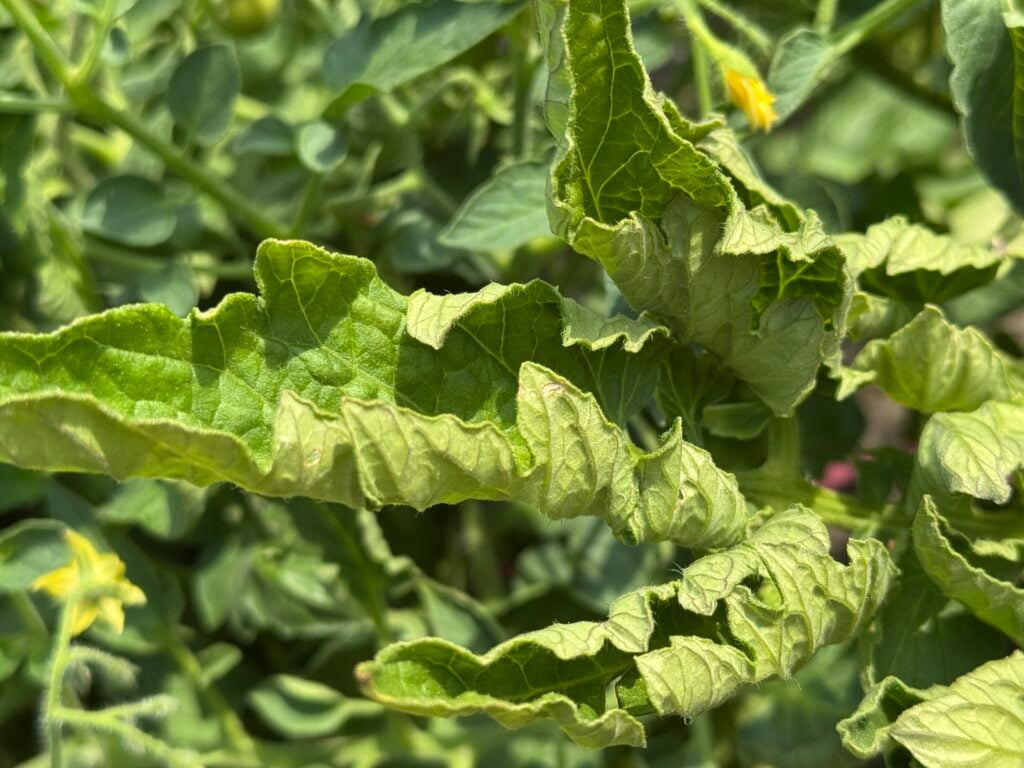
Not all leaf curl looks the same, and the direction and location of the curl often provide the first clue about what’s happening.
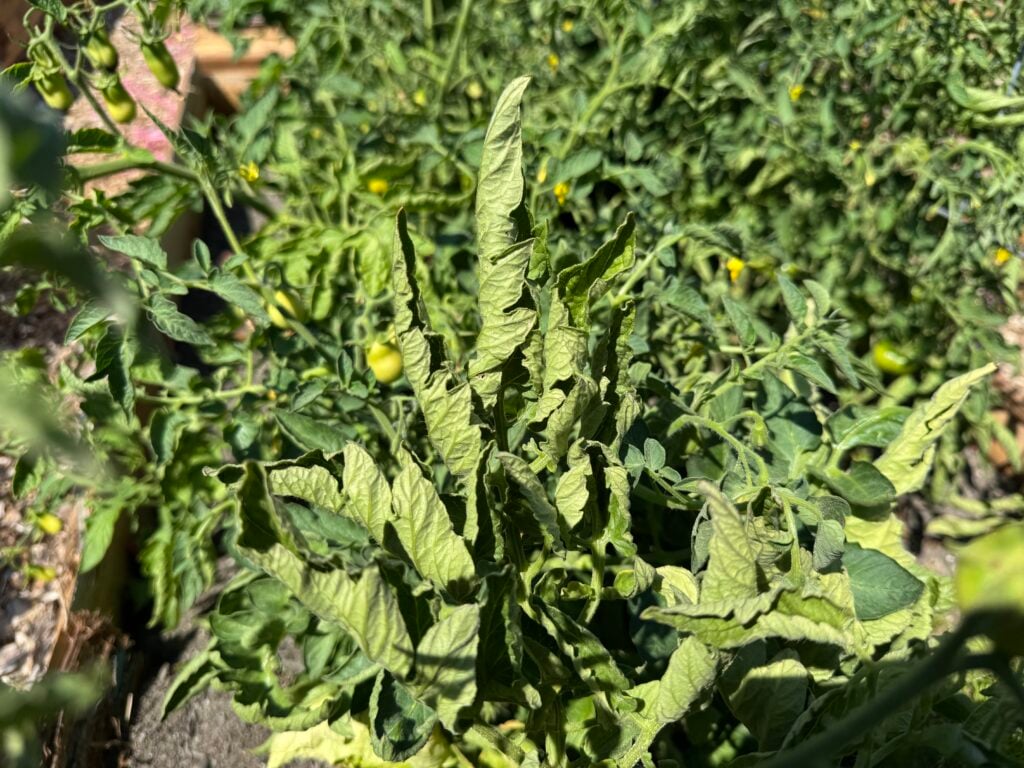
Leaves that curl upward along the edges are usually responding to environmental stress. This type of curling is especially common during periods of hot weather and is often accompanied by otherwise healthy green foliage.
Leaves that curl downward can indicate watering problems, root stress, or occasionally herbicide injury.
The most concerning type of curling occurs on new growth. If the newest leaves are twisted, narrow, distorted, or growing in unusual shapes, herbicide damage or Tomato Yellow Leaf Curl Virus become more likely possibilities.
Instead of focusing on one leaf, step back and examine the entire plant. Ask yourself:
- Are the leaves still green?
- Is the plant flowering?
- Are tomatoes continuing to develop?
- Has the weather recently turned hot?
- Did I recently transplant or prune?
The answers to these questions will usually narrow the possibilities considerably.
1. Heat Stress (The Most Common Cause)
If you’ve had several days of temperatures above 90°F, heat stress is the first place to look.
Tomatoes naturally curl their leaves to reduce moisture loss through transpiration. Think of it as the plant’s built-in survival mechanism. By reducing the amount of leaf surface exposed to direct sunlight, the plant conserves water during periods of intense heat.
I’ve seen this many times over the years on my tomatoes, and they always produce beautifully.
Fortunately, this type of curling rarely affects production if the stress is temporary.
You’ll typically notice:
- Older leaves curling first
- Healthy green color
- Flowers remaining attached
- Fruit continuing to size normally
What to do
Rather than watering lightly every day, give your tomatoes a deep soaking once or twice each week, depending on your soil type. Deep watering encourages roots to grow downward where moisture remains available longer. I only water my plants 1-2 times a week, but I water them for about 30 minutes each time to give them a really good, deep soaking.
Applying two to three inches of mulch around the base of the plant helps stabilize soil moisture and keeps root temperatures cooler.
During prolonged heat waves above 95°F, temporary shade cloth can also reduce plant stress.
2. Inconsistent Watering
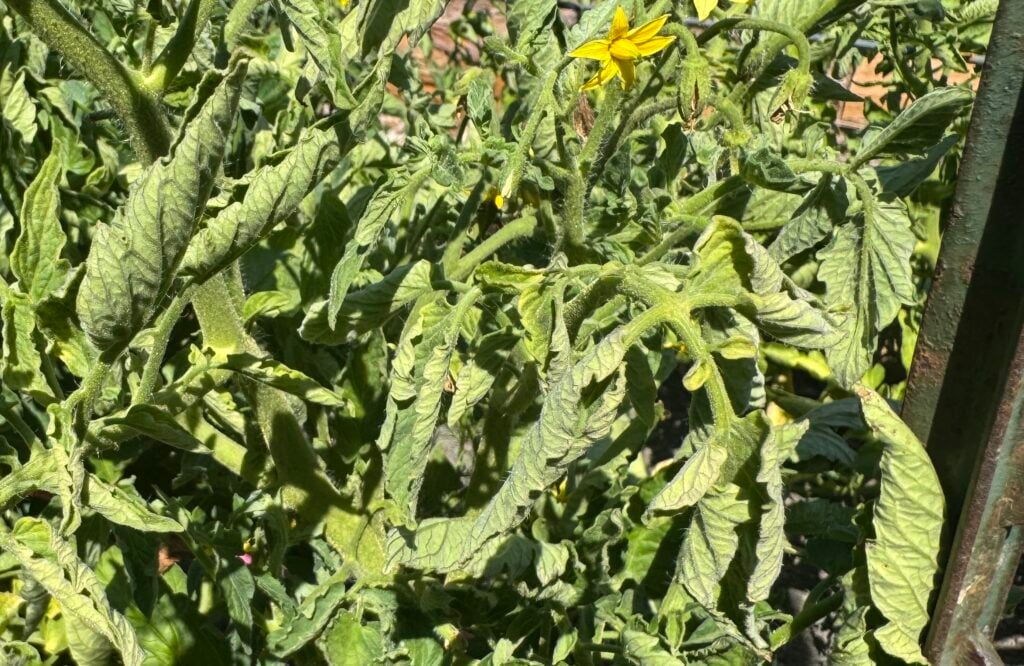
Tomatoes prefer consistency. Alternating between bone-dry soil and saturated soil places significant stress on the root system.
When roots struggle to absorb water evenly, leaves often curl as the plant attempts to balance water loss with water uptake.
Gardeners sometimes mistake this for underwatering alone, but overwatering can produce very similar symptoms because saturated soil contains very little oxygen. Roots require oxygen to efficiently take up nutrients.
Signs include:
- Curling leaf edges
- Afternoon wilting
- Cracked fruit
- Blossom end rot developing later
Check the soil several inches below the surface before watering. If it’s still moist, wait another day or two. A moisture meter is a great tool to have on hand to check moisture levels down into the soil.
3. Physiological Leaf Roll
This harmless condition is probably responsible for more unnecessary panic than any tomato disease. I’ve panicked before because of it!
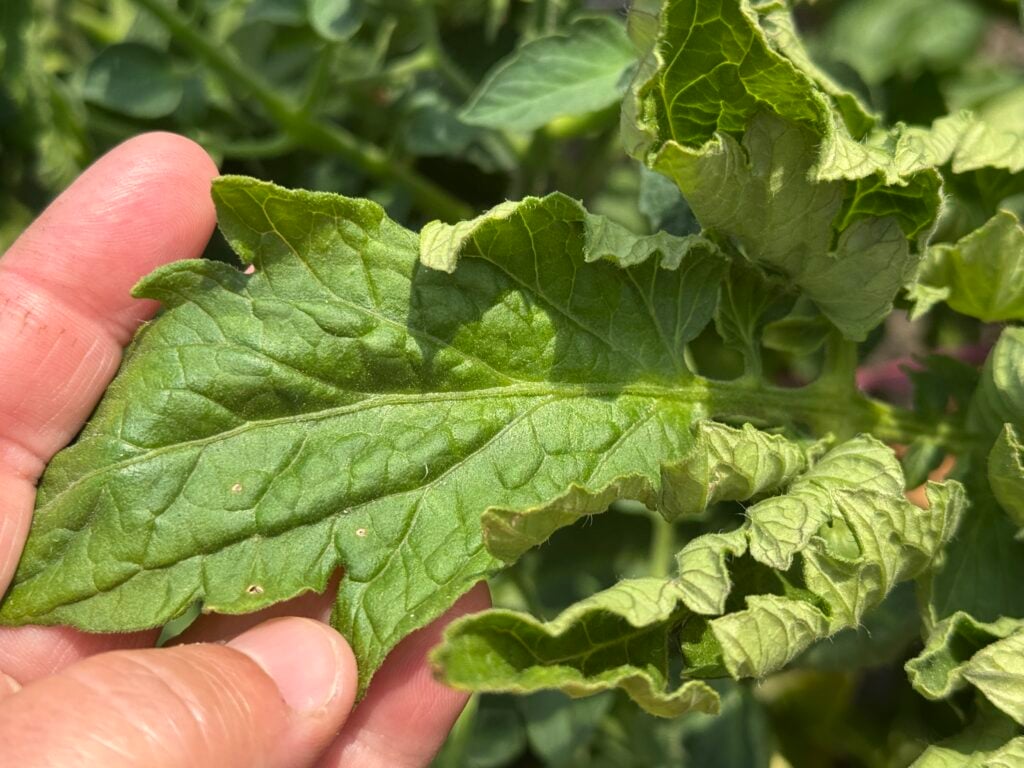
Physiological leaf roll occurs when tomatoes experience temporary stress but continue growing normally. The leaves roll tightly upward, sometimes resembling small tubes, yet remain green and healthy.
Several factors can trigger it:
- Heavy pruning
- Excess fruit load
- Hot weather
- Root disturbance
- Rapid changes in moisture
Indeterminate varieties seem especially prone to developing physiological leaf roll during midsummer.
The good news is that this condition is mostly cosmetic. I’ve had plenty of tomato plants produce excellent harvests despite having rolled leaves for weeks.
If your plant continues flowering and setting fruit, it’s usually best to leave it alone and allow it to recover naturally.
4. Transplant Shock
Newly transplanted tomatoes often curl their leaves while establishing new roots.
Moving a tomato from a container into the garden inevitably damages some fine feeder roots. Until the plant rebuilds its root system, the leaves may curl slightly as water uptake temporarily slows.
This usually improves within one to two weeks.
To reduce transplant shock:
- Water thoroughly after planting.
- Avoid fertilizing immediately.
- Protect young plants from intense afternoon sun for several days.
- Keep the soil consistently moist, but not soggy.
My guides on How to Harden Off Seedlings and When to Transplant Seedlings Outdoors will help reduce the stress on the plant.
5. Too Much Nitrogen
When tomatoes receive excessive nitrogen, they often respond by producing lush foliage instead of flowers and fruit.
You’ll typically notice:
- Dark green leaves
- Thick stems
- Curled foliage
- Few blossoms
This commonly happens when lawn fertilizer accidentally reaches vegetable beds or when gardeners continue feeding high-nitrogen fertilizer throughout the growing season.
Switching to afertilizer formulated for fruiting vegetables helps restore the balance.
6. Herbicide Drift
Herbicide injury is one of the few causes of leaf curl that cannot be corrected.
Tomatoes are extremely sensitive to broadleaf herbicides. Even small amounts drifting from a neighboring lawn treatment can distort new growth.
Symptoms often include:
- Twisted stems
- Narrow, strap-like leaves
- Severe curling
- Misshapen new growth
If only a few leaves are affected and exposure was minimal, the plant may partially recover and still produce. Severe damage, however, often results in poor production for the remainder of the season.
Avoid spraying herbicides on windy days and never compost grass clippings from lawns treated with persistent herbicides.
7. Tomato Yellow Leaf Curl Virus
Fortunately, this disease is not very common. Unlike physiological leaf roll, Tomato Yellow Leaf Curl Virus affects the entire plant.
Symptoms include:
- Bright yellow leaves
- Curled new growth
- Stunted plants
- Poor fruit production
- Whiteflies present
Unfortunately, infected plants cannot be cured.
Removing infected plants promptly helps reduce the spread of the virus to nearby tomatoes.
Thankfully, I’ve never dealt with this issue, but the University of Florida IFAS has a great article on Tomato Yellow Leaf Curl Virus if you’d like to learn more.
8. Pests
Several sap-sucking insects cause leaves to curl as they feed.
The most common include:
- Aphids
- Whiteflies
- Broad mites
Always inspect the undersides of curled leaves before assuming disease.
Small infestations often disappear naturally as ladybugs and other beneficial insects arrive. If you have a large infestation, it may require insecticidal soap or neem oil.
9. Root Damage
Healthy roots produce healthy plants with healthy leaves.
When roots are injured through cultivation, compacted soil, nematodes, or disturbance around the garden, tomatoes often respond with curled foliage because they can no longer absorb water efficiently.
Avoid hoeing deeply around tomato plants and use mulch to keep weeds down instead.
How to Diagnose Tomato Leaf Curl
Before treating anything, walk through this quick checklist.
| If you see… | It’s probably… |
| Green curled leaves during hot weather | Heat stress |
| Curling after transplanting | Transplant shock |
| Tight rolled leaves on otherwise healthy plants | Physiological leaf roll |
| Twisted new growth | Herbicide damage |
| Yellow curled leaves and whiteflies | Tomato Yellow Leaf Curl Virus |
| Dark green foliage with few flowers | Excess nitrogen |
| Curling with insects underneath leaves | Aphids, mites, or whiteflies |
Should You Remove Curled Tomato Leaves?
In most cases, no.
Curled leaves are still photosynthesizing, which means they’re still producing energy for the plant. Removing them can actually increase stress by reducing the plant’s ability to manufacture the sugars needed for growth and fruit production.
The only leaves that should be removed are those that are diseased, severely damaged, or touching the soil where they can spread fungal diseases. Check out my Tomato Pruning Guide to learn how to properly prune your tomato plant.
If the curling is caused by heat or physiological leaf roll, patience is usually the best treatment.
How to Prevent Tomato Leaves from Curling
While not every cause can be prevented, gardening practices dramatically reduce the likelihood of leaf curl becoming a problem.
- Water deeply and consistently rather than lightly every day.
- Add mulch to regulate soil temperature and moisture.
- Fertilize according to the plant’s stage of growth instead of using a high-nitrogen fertilizer throughout the season.
- Avoid excessive pruning during hot weather.
- Inspect plants regularly for insects before populations become established.
Perhaps most importantly, resist the urge to overreact. Tomato plants are remarkably resilient, and a few curled leaves rarely mean your harvest is in jeopardy.
Final Thoughts on Tomato Leaf Curl
Tomato leaf curl can look alarming, especially if it appears overnight, but it doesn’t automatically mean your plants are in trouble. More often than not, curling is simply a response to environmental conditions such as heat, inconsistent watering, or temporary stress. By slowing down and looking at the whole plant instead of focusing on a single leaf, you can usually identify the true cause and avoid unnecessary treatments.
Healthy green foliage, active flowering, and developing fruit are all reassuring signs that your tomatoes are likely to recover on their own. With consistent watering, proper mulching, and a little patience, most plants will continue producing a plentiful harvest despite a few curled leaves.
Frequently Asked Questions About Tomato Leaves Curling
Why are my tomato leaves curling but the plant looks healthy?
If your tomato plant has curled leaves but is still green, flowering, and producing tomatoes, there is a good chance the plant is responding to a temporary stress rather than suffering from a serious problem.
The most common causes are heat, inconsistent watering, recent pruning, or what is called physiological leaf roll. This is especially common during the hottest part of summer when tomato plants are working hard to keep water moving through their leaves.
Why are my tomato leaves curling upward?
Tomato leaves curling upward is often a response to heat or moisture stress. When temperatures rise, tomatoes may curl their leaves to reduce water loss through the leaf surface.
If the leaves are still green and the plant continues producing flowers and fruit, focus on keeping the soil consistently moist, adding mulch around the base of the plant, and avoiding unnecessary pruning during hot weather.
Why are my tomato leaves curling downward?
In many cases, downward curling is related to stress from inconsistent watering, root problems, or transplant shock. However, if the newest growth is twisted or distorted, herbicide exposure may also be a possibility.
Check the soil moisture first, then inspect the plant carefully for insects or unusual growth patterns.
Can overwatering cause tomato leaves to curl?
Yes, overwatering can cause tomato leaves to curl because it affects the plant’s ability to take up oxygen and nutrients from the soil.
Before watering, check the soil a few inches below the surface. Tomatoes prefer deep, consistent watering rather than constantly wet conditions.
Should I remove tomato leaves that are curling?
Usually, no. Removing healthy leaves (even when curled) can actually create more stress, especially if the plant is already dealing with heat or moisture issues.
The exception is if leaves are yellowing, diseased, severely damaged, or touching the soil. Those leaves can be removed to improve airflow and reduce potential disease problems.
Will curled tomato leaves uncurl?
Sometimes, but not always.
If the curling is caused by temporary stress such as heat, transplant shock, or inconsistent watering, newer growth often returns to normal once the plant’s growing conditions improve.
Leaves affected by physiological leaf roll or herbicide damage may stay curled for the remainder of their life.
Are curled tomato leaves a sign of disease?
Most of the time, no.
Diseases usually come with additional warning signs such as yellowing leaves, stunted growth, poor fruit production, or unusual patterns on the foliage.
If your tomato plant is green, vigorous, and producing tomatoes, it’s probably not diseased.
Can a tomato plant recover from leaf curl?
Yes, many tomato plants recover completely from leaf curl once the underlying stress is corrected.
Plants affected by heat, watering issues, transplant shock, or physiological leaf roll often continue growing and producing fruit.
The best approach is to correct the growing conditions rather than trying multiple treatments at once.
Why are only the bottom leaves on my tomato plant curling?
When only the lower leaves curl, it often points to normal plant stress or the natural aging.
Older leaves are usually the first to show signs of stress because they have been exposed to environmental conditions longer. Healthy new leaves are usually a better indicator of how the plant is doing overall.
Why are my tomato seedlings’ leaves curling?
Curling tomato seedling leaves is often caused by transplant stress, watering problems, or environmental changes.
Young plants are especially sensitive because their root systems are still developing.
Make sure seedlings receive adequate moisture, avoid overfertilizing, and protect them from sudden temperature changes while they adjust.
Can fertilizer cause tomato leaves to curl?
Yes, too much fertilizer can cause tomato leaves to curl, especially when the fertilizer contains high levels of nitrogen.
Excess nitrogen encourages leafy growth but can interfere with flower and fruit production.
How do I know if tomato leaf curl is from herbicide damage?
Herbicide damage usually affects new growth first and creates leaves that look twisted, narrow, or strangely shaped.
Herbicide injury often causes abnormal growth patterns rather than just rolled leaf edges. You may notice distorted stems or leaves that look almost stretched or “strapped.”
Does tomato leaf curl affect fruit production?
It depends.
If the curling is caused by heat, inconsistent watering, or physiological leaf roll, many tomato plants continue producing a healthy harvest.
Problems like severe herbicide damage or viral diseases are more likely to reduce fruit production.